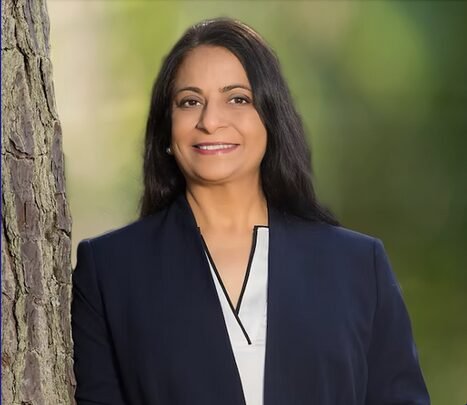
Mona Singh
Questionnaire Responses
1. Public Employee Living Wage Commitment: As a county chapter of the Progressive Caucus of the North Carolina Democratic Party, we require all candidates seeking our endorsement to pledge to advocate for and ensure that public employee salaries meet or exceed a living wage. Please read and sign the pledge here before continuing your endorsement application: https://www.pcncdp.org/pledge. Once you have signed the pledge, please indicate doing so below:
a. [I have signed the Public Employee Living Wage Pledge!]
b. [I have chosen not to sign the Public Employee Living Wage Pledge at this time.]
Do you support placing limits on the size of campaign donations for candidates running for positions on the Wake County Commission? If so, what should be the maximum amount for all categories of donations? Additionally, have you accepted contributions from the real estate industry or its executives? If yes, from which entities, and why did you accept those contributions? Please explain your position and reasoning.
Yes, I am in favor of campaign finance reform for all elections. Any limit on donations that applies to all would be fine for me.
However, more than the size of the donation, what’s concerning is if there is a quid pro quo. Often, the people who seek to manipulate elected officials find ways to raise donations that are individually below any threshold and yet add up to large amounts. Thus, lowering the threshold from the state limit by itself wouldn’t solve the problem.
My financial support has mostly come from the people who have known me a long time and a few who have known me only since this campaign began but have found my vision compelling. I have worked with many of my contributors for years on efforts such as helping the homeless and refugees, participating in political events such as protests against Trump’s Muslim Ban, collaborating on Interfaith activities, and volunteering for the Democratic Party since 2008. Many of these people are or were members of the local Indian community; most are professionals in medicine or technology though some are in business. Of these, a few have real-estate businesses.
I took funds from a PAC, whose principals I know through the Sikh community and their participation in efforts to help the homeless and refugees. Even though they do not build in unincorporated areas of Wake, I decided to return their funds. I have not accepted contributions from any of the builder PACs.
I affirm that there is no quid pro quo for any donation my campaign has received. I will recuse myself from decisions by the Commission pertaining to any matter concerning any of my contributors
How will you ensure that the County fully funds public schools, universal preschool, provide a living wage for support staff and supplement the salaries for teachers to provide a living wage for Wake County? What strategies would you use to address funding gaps and prioritize equity in education?
I have lived with educators all my life, as a daughter of a teacher and as the wife of a university professor. I taught at the University of Texas at Austin as an Instructor. I appreciate the transformative power of education in raising the quality of life, not just of an individual but of a community, and not just in economic terms.
My commitment to public education is unwavering. I will ensure that public schools (and preschools) get the funding they require, despite federal and state cuts, to provide quality education to our students.
I will raise these funds from improved County operations and new bond referendums (benefiting, where possible, from reducing interest rates to lower our debt service and capital expenditures). I have improved business operations, increasing net revenues by 33% to over $1 billion and innovated extensively (134 US patents). I will apply this expertise in data-driven management and innovation thinking at the Commission.
I will invest into upskilling our staff as a way to improve operations. The power of well-trained employees saving public funds was demonstrated by BART (the metro system of the San Francisco Bay Area) lowering costs by 15% on a major project.
This article recognizes the value of BART’s staff in this project.
Going beyond the necessities of school infrastructure and qualified staff, one way we can combat inequity in education is by engaging the community. We have a unique opportunity in Wake County of a phenomenal pool of educated people and especially retirees who want to give back to the community. I will work to measurably advance community participation in education by promoting programs such as Communities in Schools for mentoring students so that students whose families may lack college-educated adults can benefit from the experience and expertise of retirees, especially to enhance STEAM offerings across our schools. Besides a direct payoff in engaging kids in education, these efforts will improve the social fabric in Wake County by bridging communities across cultural and socioeconomic backgrounds and mother tongues.
How will you allocate county funds to provide full coverage for community college education for high school graduates, and how will you prioritize workforce development programs, including clean energy and other high-demand sectors, to ensure equitable access and good-paying jobs?
As I know from my own career, new technologies and business practices emerge in surprising ways. Therefore, I will ensure not only that Wake Tech has the resources, both staff and infrastructure, to keep its curricula up-to-date with new technology but also that it has offerings for adults to upskill themselves, especially in industries that are gaining prominence in the County. Even people who are currently employed may future-proof their employability by preparing for upcoming careers.
A big challenge for Wake Tech students with children is child care and especially so for working adults, especially women and single parents. I will examine how to expand options for all, including child care grants and universal preschool.
Wake Tech has a strong partnership with the public school system. The Cooperative Innovative High Schools program enables students to earn a high school diploma while earning credits for an associate degree. Another valuable program is for apprenticeship opportunities for students at local companies. I will seek resources to expand such programs from four schools currently, including staff (for teaching and coordinating with outside stakeholders) and transportation solutions so they are viable for students without personal cars.
To offset some of the cost for curricular improvements, I will foster closer relationships with leading employers of Wake Tech graduates. These companies can contribute financially, hire student interns, and provide experienced employees as adjunct teaching staff to bring real-world experience to guide students. Given the cost to a company of recruiting qualified employees, such support by them would be beneficial to them, not just to students.
Broadband access for all and County libraries are crucial to workforce development. Not only do libraries level access to knowledge, they also provide computers for learning and job search and facilities to use for job interviews. I will try to ensure that libraries across the County have modern resources and new libraries are architected for all these essential purposes with agility in meeting future community needs.
As described above for public education, I will seek funds through cost savings in County operations and through bonds for infrastructure.
How will you utilize county funds to establish, expand, and fully fund Mobile Crisis services routed through Public Safety Telecommunicators and Call-Takers. to respond to mental health and substance use issues, and what steps will you take to ensure these services are accessible countywide?
Mental health and substance abuse crises are social work and community challenges rather than police challenges. I will advocate for instituting a system of community social workers; such a worker would live in the community they serve and build trust with community members by helping them navigate County services. If we had one worker per precinct, we would need 217 workers and each would help a population of about 6,000 on average. The cost of paying them a stipend plus expenses (e.g., for car use) would be more than offset by reducing the need for more expensive services such as emergency policing and healthcare and reducing misery by avoiding some unpleasant fallouts such as violence.
People who need mental health and substance abuse help often need it more than once. Thus, we can acquire data about their specific case along with the social worker adding social knowledge, e.g., about whether they are going through job loss or a divorce. This knowledge can help improve targeting of the services for each incident, including routing mobile crisis calls better, and before an incident occurs, bringing up softer interventions such as alerting a peer volunteer to chat with an at-risk person to ease their anxiety or remind them to take their medication. The idea is to support a 24×7 service while minimizing the involvement of traditional police and healthcare.
As a foreign-born candidate, I recognize the importance of language services and want to make sure that immigrants are served. Even immigrants who speak English well enough for their job may need language support for mental health crises when they feel emotions they cannot easily express in English. The model minority myth serves to diminish the needs of Asian immigrants, not only Spanish-speaking ones, and we have to fight this myth through our actions.
Do you support placing a bond referendum on the next Wake County ballot to fund solar panel installation on public buildings? How will you also use county funds to address affordable housing preservation, promote mixed-income developments, and advance climate resilience in vulnerable communities? Why or why not?
I will support a bond referendum for rooftop solar panels on public buildings and parking lots.
For climate resilience, I will focus on flooding risk.
First, minimizing nonabsorbent pavements (e.g., concrete), and promoting native vegetation can reduce flooding and protect local flora and fauna, provided we don’t add to fire risk.
Second, keeping our creeks and waterways clear is a wise investment.
Third, we should continually reevaluate our zoning guidelines as flooding risk changes.
Fourth, we ought to transition away from fossil fuels. I will support placing EV chargers in public parking lots and along streets to reduce reliance on private fast chargers, exploring partnerships with companies that install and operate such chargers with no outlay from the County, ensuring equity in placement.
By volunteering with the homeless and refugees, I have seen the challenges of housing affordability, especially for families with children. With over 65 people moving into the County every day, the County is falling behind in housing. A deficit of over 110,000 units is projected by 2029.
I will seek to increase the supply of low-cost multi-unit homes.
First, we should reengineer the County’s planning processes, gathering data, and improving transparency without affecting our collective objectives such as protecting the environment or building safety.
Second, we should reevaluate land-use requirements such as parking minimums, which raise construction cost and lead to reduced tree cover. An improved transportation infrastructure would reduce the need for private vehicles (and thus parking).
Third, we ought to reduce regulatory fees for affordable homes.
Fourth, I will evaluate emerging technologies such as 3D printing homes (with concrete) for low-cost housing.
Smart growth (mixed-use, transit-accessible development) tackles climate resilience and housing needs together by minimizing sprawl and expanding shared open spaces. I would explore opportunities for building in places in the County that already have space, road capacity, power, water, and sewage, where adding an apartment complex would be not disruptive to current residents or to the environment.
How will you support the establishment of a local Truth and Reconciliation Commission, and what specific topics or systemic issues should it examine to promote racial equity and community healing?
Equity is a core American value. Irrespective of what is happening at the national level, we need to make sure that Wake County welcomes all and allocates its resources equitably. Therefore, equity should be woven into every service provided by the County.
I will work to specify clear performance metrics for equity, make sure we have the data to compute those metrics, and continually validate the metrics themselves through qualitative studies of the relevant groups. Specifically, I will advocate for thorough data collection and analysis, in collaboration with our municipalities, to make sure that we can identify any inequities across dimensions such as race, national origin, immigration status, geography, and income.
There is room for improvement in our data gathering and analysis. As an important case, notice that the County has enacted a nondiscrimination ordinance (as have most of our municipalities) that allows for complaints on grounds of discrimination. I will ensure that the relevant data is collected, analyzed for trends over the above dimensions, and used to detect emerging problems and drive measurable improvements in outcomes.
I will support a local Truth and Reconciliation Commission focused on historical accountability for past racial harms. Although informal efforts such as by students are valuable, an official County initiative would be able to engage a wider swath of the population, provide formal recognition of truths about part harms, and identify paths for reconciliation at a personal level as well as restoration through public acknowledgment.
How will you allocate resources to fully fund County Health and Human Services programs, with attention to preventive care, substance use treatment, and reducing health disparities among marginalized populations?
I will advocate for adequate funding for County Health and Human Services, emphasizing prevention (free immunizations, needle exchanges, public education about hygiene and available programs) and early intervention (improved access to health clinics) to reduce costs. I will evaluate if we can increase the number of regional clinics and expand telehealth options so that a sick person doesn’t suffer unnecessarily or infect others at work, school, or in a bus.
To reduce disparities, first, immediately, I will work with members of low-income and immigrant communities in Wake County to understand their health needs and stories. Based on this understanding, I will ensure that appropriate funds are allocated to services such as maternal and child health, and immunizations, to help these communities.
Second, for immigrant communities, in addition, I will ensure that there is adequate language support and that these services are suitably advertised (e.g., through radio and social media, partnerships with ethnic stores and places of worship) so that the target populations are aware of what is available. Besides language, a cultural factor is that different communities have cultural events: such events can be used as an opportunity for attracting participation via partnership with community leaders and to lower superspreader risk from large gatherings.
Third, I will institute data gathering and analysis protocols so we can continually track demand for various health services and how well that demand is fulfilled. This data will enable dynamic reallocation of resources to different parts of the County and in different seasons.
Fourth, I will advocate setting up a network of social workers (and volunteers) in each community. This network can help spread the word about the available public health services and encourage participation in them, while also helping individuals with their specific needs, including administrative help in signing up for programs such as Medicaid. Because of cuts to Medicaid (and programs such as CHIP) I expect fewer residents will qualify for them. However, if we can make sure that all who qualify are enrolled, that will help them and produce revenue for the County.
How will you ensure that Wake County’s budget and policy decisions are transparent and that residents have meaningful opportunities to participate in governance, particularly communities historically excluded from decision-making?
I am an advocate of people-driven governance and of community engagement. I will investigate online tools that the County can host to help neighborhood communities to deliberate on problems that matter to them and exchange ideas about alternative solutions. When these problems and solutions affect larger regions within the County, they can provide a good starting point for further discussion, e.g., in public meetings. When people feel empowered it would improve the social fabric of life in the County and yield further intangible benefits such as through improved prosocial behaviors.
The County Commission is the steward of the public’s money, to the tune of $2.1 billion each year. Although the County budget is public, information at a more granular level is not easy to locate. I will advocate for increased transparency by making County financials easy to read. Further, I will advocate clear public guidelines and processes for any expenditures, so that the public can legitimately trust that all funds are expended in the interest of the County’s residents.
As part of good governance, I would ask for tracing of any concern that a resident raises, so it is properly addressed and the resident and other members of the public can see how it was addressed. Please also see my comment about Wake’s nondiscrimination ordinance above.
I will advocate for a diversity panel that residents can reach directly and which will have visibility at the Commission to enhance accountability. My goal with this panel is to use it not as a path for criticism, but as a driver for process refinement so that every instance of failure turns into an opportunity for continually improvement in how the County becomes a safe and welcoming place for all.
How will you ensure that professional and family caregivers are paid a living wage, programs supporting elders and persons with disabilities are fully funded and accessible, and that low-income seniors are protected from excessive utility costs (for example, through automatic circuit setters or other measures)? Please explain your approach and reasoning.
The County Commission is not empowered to set the minimum wage for businesses. However, I will ensure that caregivers for children, the elderly, or the disabled who are employed by the organizations that receive county funding earn a living wage.
There is a program to support family caregivers of children at risk of entering the child welfare system. I will analyze the data to understand how effective that coverage is, and to understand the costs involved in expanding it to elderly residents, who too need personal assistance.
Wake County offers programs to help seniors with their utility bills. These programs are funded based on federal and state grants and are limited to households with low incomes (e.g., 130% of the federal poverty income) or resources. The federally funded Low Income Energy Assistance Program (LIEAP) is funded (though delayed by the shutdown). Some of the other programs, e.g., both North Carolina’s Temporary Assistance for Needy Families (TANF) program and the WCEA (Wake County Emergency Assistance Program for Energy Assistance), have no funding. I will advocate increasing the income limit to a realistic number and supporting the poor people who miss the LIEAP income eligibility. I will gather and analyze the data to understand why a household is unable to pay its utility bill. Interventions for energy efficiency (which also promote sustainability), such as fixing drafty windows or repairing HVAC units can reduce these bills, and the County should give grants or loans to cover such expenses.